
the North Olympic Peninsula Lead Entity for Salmon
North Olympic Peninsula Lead Entity for Salmon: Salmon for today. Salmon for tomorrow.
The North Olympic Peninsula Lead Entity for Salmon brings together local governments, tribes, technical experts, nonprofit organizations, citizens, and other partners to coordinate and advance salmon recovery across the North Olympic Peninsula. The group works to identify priorities, develop projects, and pursue funding for salmon recovery efforts, including habitat restoration.
Our Mission
NOPLE works to support a healthy Puget Sound ecosystem and abundant salmon populations on the North Olympic Peninsula, with the long-term goal of sustaining ceremonial, subsistence, recreational and commercial fisheries.
Lead Entity Area
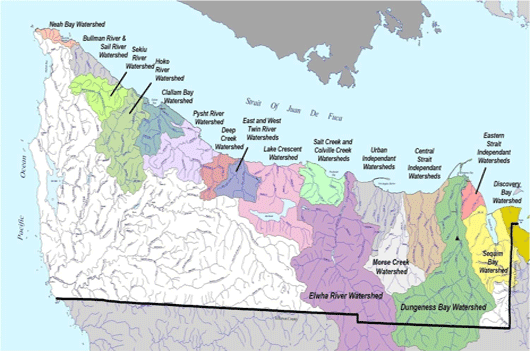
We work to advance salmon recovery, protection and restoration from Clallam County’s eastern boundary near Gardner, along the Strait of Juan de Fuca and Morse Creek in Port Angeles, and west past the Elwha, Lyre, Clallam and Sekiu Rivers to Cape Flattery in Neah Bay, the most northwest corner of the contiguous United States. It includes the western portion of Water Resource Inventory Area (WRIA) 17(Quilcene- Snow), WRIA 18 East (Dungeness), WRIA 18 West (Elwha-Morse) and WRIA 19 (Lyre- Hoko). We can support restoration efforts in any of our many watersheds, but particular areas are prioritized in relation to factors such as their size, condition, endangered species, number of salmon populations, and potential for increased salmon populations.
Goals
- Achieve fish stocks that are robust to changing conditions, self-sustaining over the long term, and capable of supporting ceremonial, subsistence, recreational and commercial fisheries.
- Implement actions in the salmon recovery plans to protect and restore fish habitat on the North Olympic Peninsula.
- Restore & maintain ecosystem function on the North Olympic Peninsula.
- Instill ecosystem awareness.
- Integrate efforts towards these goals with larger visions for overall salmon recovery and restoration of the Puget Sound ecosystem.
- More goals are outlined in the Strategy of the North Olympic Peninsula Lead Entity for Salmon.
Learn More About Us
Bylaws for the North Olympic Peninsula Lead Entity for Salmon
View the original amended bylaws approved February 19, 2021 (DOCX)
Section I: Introduction, Mission, and Scope
Introduction:
The North Olympic Peninsula Lead Entity for Salmon is a coalition that works with its members, partners and other stakeholders to coordinate, integrate, and implement local salmon recovery efforts. Our membership includes local governments, tribes, technical experts, non-profits, and citizens. We identify, prioritize, develop and seek funding for needed salmon recovery efforts, including, but not limited to habitat restoration.
Our Mission:
We are working towards a future on the North Olympic Peninsula with a healthy Puget Sound ecosystem and abundant salmon populations that support ceremonial, subsistence, recreational and commercial fisheries.
Lead Entity Area:
Our geographic area stretches from Clallam County’s eastern boundary near Gardner all along the Strait of Juan de Fuca west to Cape Flattery. It includes the western portion of Water Resource Inventory Area (WRIA) 17 (Quilcene- Snow), WRIA 18 East (Dungeness), WRIA 18 West (Elwha-Morse) and WRIA 19 (Lyre-Hoko).
Section 2: Initiating Governments
Initiating Government Participants:
The Initiating Governments are counties, cities, and tribes within our geographic area. They include the Jamestown S’Klallam Tribe, the Lower Elwha Klallam Tribe, the Makah Tribe, the City of Port Angeles, the City of Sequim, and Clallam County.
Initiating Government Responsibilities:
Responsibilities of Initiating Government Members are:
- Appointing their government’s representative (and designate an alternate if they choose).
- Appointing a representative (and designate an alternate if they choose) to serve on the Lead Entity’s Technical Review Group.
- Appointing Citizen Lead Entity Group Members
- Forming the Lead Entity with the State of Washington.
- Establishing and approving the bylaws, as well as any bylaw changes.
- Selecting a Contracting Agent for the Lead Entity.
- Making recommendations to the Contracting Agent regarding hiring a Coordinator.
- Defining the Lead Entity’s Geographic Boundaries
- Participating as part of the Lead Entity Group to meet their designated responsibilities.
Decision-Making by the Initiating Governments:
Agreement of all Initiating Government Members is required for:
- Changing or amending bylaws.
- Forming, restructuring, or dissolving the Lead Entity.
- Selecting a Contracting Agent for the Lead Entity.
- Appointing Citizen Lead Entity Group Members.
- Changing Citizen Member term length (Note: all Citizen Member terms must be for the same length of time, i.e. 1 year, 2 year, etc.).
- Specifying if increased or decreased citizen participation is desired.
Section 3: The Lead Entity Group
The Lead Entity Group:
The Lead Entity Group (LEG) includes Initiating Government Members and appointed Citizen Members. Lead Entity Group Membership shall be consistent with the Washington State Salmon Recovery Act (RCW 77.85) and, to the degree possible; reflect interests identified in the statute. The Group will strive to maintain representatives from all Initiating Governments and three Citizen Members.
Citizen Members: When making Citizen Appointments, the Initiating Government Members shall strive for geographic understanding and diversity. However, Citizen Members, like their Initiating Government and Technical Review Group counterparts, should come to the table with a “big picture approach.”
Ex Officio Members: To provide needed expertise and build stronger partnerships, Ex Officio Members may be asked to participate in the Lead Entity Group.
Terms of Office: Those appointed by their Initiating Government as LEG Members serve until their government chooses to make another appointment.
Citizen or Ex Officio Lead Entity Group Members are appointed for two year terms. They can be reconsidered for reappointment when their term expires.
Lead Entity Group Participation:
It is encouraged that members actively participate by attending all regularly scheduled meetings. The Lead Entity Group considers three consecutive unexcused absences of a member or alternate representative from the regularly scheduled meetings as an abandonment of post and is subject to termination of position. An unexcused absence is when a member misses a meeting with no prior communication about their unavailability prior to the meeting.
Decision-Making by the Lead Entity Group:
The goal is to operate by general consensus. When consensus is not possible, decisions will be made by a simple majority vote, unless the specific decision is covered elsewhere in this document.
Decision-making by consensus takes the views of each participant into account. Every member has an opportunity to voice their opinion, or block a proposal if they are strongly opposed to a particular decision. Conflicts will be resolved through negotiation until consensus is achieved, a vote is called for, or the item is tabled. Members may choose to abstain from a particular consensus process.
Reasons for any dissent on decisions will be documented in the meeting minutes. If arranged in advance, members may vote via phone or e-mail on specific issues.
A quorum of 5 members is required to make decisions. That includes at least 3 Initiating Government Members.
Lead Entity Group Responsibilities:
Responsibilities of Lead Entity Group Members are:
- Prioritizing the North Olympic Peninsula Lead Entity Project list, which is generally forwarded annually to the Salmon Recovery Funding Board (SRFB) for SRFB & Puget Sound Acquisition and Restoration (PSAR) dollars (when available).
- Approving the process in which new projects are added to the Lead Entity’s short-term and long-term workplans, as well as the process in which the projects are scored and ranked.
- Determining where to establish priority projects on the workplan that are eligible to apply for funding.
- Reviewing the Annual Budget, as well as Lead Entity biannual narrative and budget reports.
- Establishing Ground Rules and Conflict of Interest Policies.
- Appointing Technical Review Group Members.
- Appointing Ex Officio Members.
- Establishing Committees and Subcommittees
Section 4: The Technical Review Group
The Technical Review Group:
The Technical Review Group (TRG) is an advisory committee to the Lead Entity Group that is primarily responsible for technical input. Each Initiating Government appoints one member to the Technical Review Group and the Lead Entity Group appoints others. Other positions on the Technical Review Group are considered and appointed by the Lead Entity Group.
The Lead Entity Group remains open to reviewing applications of those interested in serving on the Technical Review Group throughout the year. It is preferable to recruit and add new members prior to the annual updated three-year workplan. Those interested in serving on the Technical Review Group are requested to send a resume and written letter of interest via e-mail to the Lead Entity Coordinator, who will bring it to the Lead Entity Group for consideration.
Terms of Office: Those appointed by their Initiating Government as Technical Review Group Members serve until their government chooses to make another appointment.
Decision-Making by the Technical Review Group:
- The goal is to operate by general consensus. When consensus is not possible, decisions will be made by a simple majority vote, unless the specific decision is covered elsewhere in this document.
- Decision-making by consensus takes the views of each participant into account. Every member has an opportunity to voice their opinion, or block a proposal if they are strongly opposed to a particular decision. Conflicts will be resolved through negotiation until consensus is achieved, a vote is called for, or the item is tabled.
- Members may choose to abstain from a particular consensus process. Reasons for any dissent on decisions will be documented in the meeting minutes.
Technical Review Group Responsibilities:
Responsibilities of Technical Review Group Members are:
- Developing watershed and salmon recovery strategies and three-year workplans, which are forwarded to the Lead Entity Group for approval.
- In partnership with the Lead Entity Group, developing scoring criteria and weightings, which are used to score and rank project concepts and projects proposed for funding.
- Scoring projects proposed for funding and project concepts proposed for the three-year workplan. This work follows decision-making criteria previously established and approved by the Lead Entity Group.
- Providing suggestions and assistance to strengthen needed salmon restoration and recovery efforts. Suggesting work needed to further the organization’s mission.
- The Lead Entity Group may request the Technical Review Group to undertake other technical tasks that will benefit the work of the North Olympic Peninsula Lead Entity for Salmon.
Section 5: Conflict of Interest & Appearance of Fairness
Conflict of Interest & Appearance of Fairness:
Both Lead Entity Group & Technical Review Group Committee Members are expected to recuse themselves from reviewing any applications in which they have a prior involvement or interest. Technical Review Group Members must recuse themselves from scoring projects or workplan project proposals in which they are a project applicant/sponsor.
Specifically, a conflict of interest, and the resultant appearance of fairness issue occurs if the reviewer:
- Has financial ties to the applicant;
- Sits on the applicant’s Board of Directors
- Stands to benefit directly from the proposed project’s completion; or
- Has contributed directly to the development of the proposal
Prior knowledge of the proposal or prior contact with the applicant does not constitute a conflict of interest, as long as none of the above criteria apply to the reviewer. If you have any concerns or questions about whether your relationship with an applicant or proposal warrants recusal, please explain your situation to the other members at the meeting where a vote is to take place. If there’s a problem that can’t be resolved within the group, it will be advanced to the Lead Entity Group for their consideration. They will decide jointly whether it constitutes a potential conflict of interest/appearance of fairness issue.
All members must complete a Public Disclosure Form as part of the grant round process.
Members with a conflict of interest in the outcomes shall abstain from voting.
Section 6: The Contracting Agent
The Contracting Agent:
The Contracting Agent is the legal organization responsible for contracting with the Washington Recreation and Conservation Organization for Lead Entity Program funding. The contracting agent is responsible for hiring/contracting a North Olympic Peninsula Lead Entity Coordinator (upon the recommendation of the Initiating Government members), accounting for budget revenue and expenditures, purchasing supplies, and administering office space.
The Contracting Agent at this time is Clallam County.
Section 7: The Coordinator
The North Olympic Peninsula Lead Entity Coordinator: The North Olympic Peninsula Lead Entity Coordinator takes direction from the Initiating Governments, but reports to the Contracting Agent. The Lead Entity Coordinator organizes and facilitates the meetings.
Approved at the February 19th, 2021, Meeting of the North Olympic Peninsula Lead Entity for Salmon.